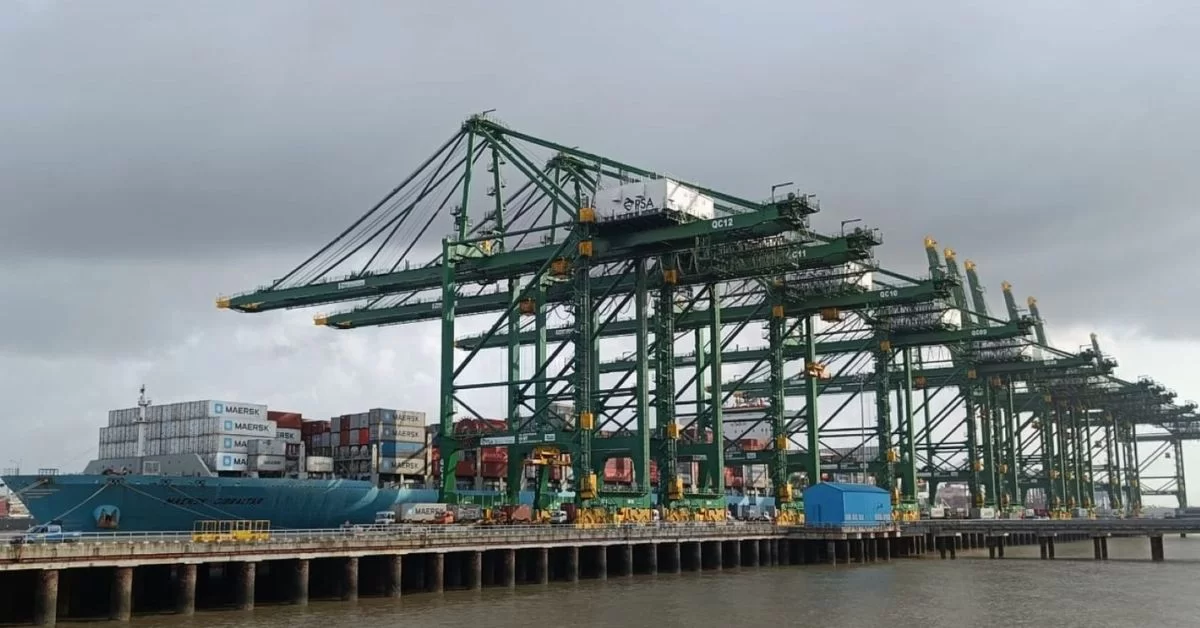
PSA Mumbai’s Phase-II inaugurated, creating India’s largest container terminal
Sep 8, 2025
Prime Minister Mr Narendra Modi and Mr Lawrence Wong, Prime Minister of Singapore, last week virtually inaugurated the PSA Mumbai Terminal (BMCT) Phase-II, at JN Port, marking a new era of India-Singapore cooperation.
With world class capacity, advanced infrastructure, seamless multimodal connectivity and a strong focus on sustainability, BMCT Phase-II will expand India’s trade potential, reduce logistics costs, create jobs and strengthen India’s global competitiveness, reinforcing India’s position as a trusted hub for global commerce.
With the inauguration of its Phase-II expansion, PSA Mumbai is poised to become India’s largest container terminal, doubling its annual handling capacity to 4.8 million TEUs. Besides, JN Port becomes India’s largest container port with a capacity of over 10 million TEUs. It is a testament to the efficiency, dedication and collective spirit of India’s maritime sector.
Designed to accommodate multiple mega container vessels alongside with 2,000 metres of continuous quay length, PSA Mumbai is built to support India’s growing trade volumes for domestic and global markets. This development is the result of SGD 1.7 billion (USD 1.3 billion) committed by PSA under a public-private partnership model, the largest foreign direct investment from Singapore in India to date.
Since its first investment in India in 1998, PSA has steadily expanded its presence across the country, emerging as a leading force in supporting India’s maritime growth. Today, PSA India operates container terminals in Navi Mumbai and Chennai, container freight stations in Mumbai and Mundra through its subsidiary PSA Ameya, and collaborates with its affiliate supply chain business PSA BDP to serve a wide range of multinational customers across diverse industry verticals.
The inauguration, on September 4, 2025, commenced with speeches delivered virtually from New Delhi by Prime Minister Narendra Modi and Prime Minister of Singapore Mr Lawrence Wong, during Prime Minister Wong’s official visit to New Delhi. After the speeches, a commemorative foundation stone was virtually unveiled to mark the official opening of the new berths at PSA Mumbai for container handling operations.
Mr Sarbananda Sonowal, Union Minister of Ports, Shipping & Waterways, was present during the exchange of MoUs in the presence of the two Prime Ministers.
The inauguration ceremony at the terminal was graced by Mr Shantanu Thakur, Union Minister of State for Ports, Shipping & Waterways, Mr Devendra Fadnavis, Chief Minister of Maharashtra, Mr Unmesh Sharad Wagh, IRS, Chairperson of Jawaharlal Nehru Port Authority (JNPA), Mr Gobu Selliaya, Managing Director - PSA India, and Mr Ashwin Arvind, Deputy Executive Director, PSA Mumbai, among other key luminaries.
Mr Unmesh Sharad Wagh welcomed the dignitaries and highlighted the significance of PSA Mumbai (BMCT) Phase-II for the maritime sector. JNPA continues to remain committed to creating world class infrastructure that ensures ease of doing business and seamless services for stakeholders, while keeping pace with evolving global shipping demands, he said.
Mr Ong Kim Pong, Group CEO, PSA International, said: “PSA Mumbai’s Phase 2 expansion brings together capacity, connectivity and sustainability in a terminal for India — a catalyst for advancing India’s trade ambitions. PSA Mumbai’s enhanced capacity of 4.8 million TEUs will reinforce the resilience of supply chains within and beyond India, and bolster PSA’s global network of port ecosystems. This milestone underscores the transformative power of purposeful collaboration between the public and private sectors to enhance global trade flows and uplift communities. Our partnership with the Jawaharlal Nehru Port Authority (JNPA) for PSA Mumbai exemplifies this commitment. Driven by this shared purpose, PSA is proud to partner India on its journey of transformational growth and progress.”
Six DFC-compatible tracks
At the inauguration ceremony, a video showcased PSA Mumbai’s active rail connectivity, featuring six Dedicated Freight Corridor (DFC)-compatible tracks that link the terminal from Jawaharlal Nehru Port (JNP) in Maharashtra to over 63 Inland Container Depots (ICDs) across India. When the Western DFC is fully connected to JNP, PSA Mumbai’s DFC-ready infrastructure will enable importers and exporters to experience a boost in multimodal logistics efficiency. This aligns with India’s vision for integrated and sustainable logistics, as outlined in the country’s National Master Plan, PM Gati Shakti.
Constructed on 200 hectares of land, the terminal brings together enhanced yard capacity and multimodal infrastructure to efficiently support India’s maritime connectivity. With electrical equipment already powered by renewable energy and progressive electrification of diesel assets, PSA Mumbai is designed to uplift trade sustainably.
Beyond infrastructure, PSA Mumbai has created over 1,500 jobs across technical, supervisory and administrative roles, including crane operators, logistics coordinators and systems analysts, providing valuable higher-skilled employment opportunities in India’s port sector, highlighted a communique.
Please visit our youtube channel https://www.youtube.com/@ikargos2719 for fortnightly logistics news analysis and more!